 c. 1830, the Louvre, Paris. Rise up and cast off your chains!
Showing posts with label romanticism. Show all posts
Showing posts with label romanticism. Show all posts
Friday, July 22, 2011
LIBERTY LEADING THE PEOPLE, by Eugene Delacroix
c. 1830, the Louvre, Paris. Rise up and cast off your chains!


Saturday, July 2, 2011

Thursday, June 30, 2011
Sonnet from a Letter, by John Keats
O thou whose face hath felt the Winter's wind,
Whose eye has seen the snow-clouds hung in mist
And the black elm tops 'mong the freezing stars,
To thee the spring will be a harvest-time.
O thou, whose only book has been the light
Of supreme darkness which thou feddest on
Night after night when Phoebus was away,
To thee the Spring shall be a triple morn.
O fret not after knowledge- I have none,
And yet my song comes native with the warmth.
O fret not after knowledge- I have none,
And yet the Evening listens. He who saddens
At thought of idleness cannot be idle,
And he's awake who thinks himself asleep.
c. 1818
One of the best poems ever on the Via Negativa.
Whose eye has seen the snow-clouds hung in mist
And the black elm tops 'mong the freezing stars,
To thee the spring will be a harvest-time.
O thou, whose only book has been the light
Of supreme darkness which thou feddest on
Night after night when Phoebus was away,
To thee the Spring shall be a triple morn.
O fret not after knowledge- I have none,
And yet my song comes native with the warmth.
O fret not after knowledge- I have none,
And yet the Evening listens. He who saddens
At thought of idleness cannot be idle,
And he's awake who thinks himself asleep.
c. 1818
One of the best poems ever on the Via Negativa.
Sunday, June 19, 2011
THE LAMB, by William Blake
Little Lamb, who made thee:
Dost thou know who made thee?
Gave thee life and bid thee feed
By the stream & o'er the mead;
Gave thee clothing of delight,
Softest clothing, wooly, bright;
Gave thee such a tender voice
Making all the vales rejoice?
Little Lamb, who made thee?
Dost thou know who made thee?
Little Lamb, I'll tell thee,
Little Lamb, I'll tell thee:
He is called by thy name,
For he calls himself a Lamb.
He is meek & he is mild;
He became a little child:
I a child & thou a lamb,
We are called by his name
Little Lamb, God bless thee.
Little Lamb, God bless thee.
Dost thou know who made thee?
Gave thee life and bid thee feed
By the stream & o'er the mead;
Gave thee clothing of delight,
Softest clothing, wooly, bright;
Gave thee such a tender voice
Making all the vales rejoice?
Little Lamb, who made thee?
Dost thou know who made thee?
Little Lamb, I'll tell thee,
Little Lamb, I'll tell thee:
He is called by thy name,
For he calls himself a Lamb.
He is meek & he is mild;
He became a little child:
I a child & thou a lamb,
We are called by his name
Little Lamb, God bless thee.
Little Lamb, God bless thee.
Wednesday, February 2, 2011
Snowflake: a Faery Tale

Snowflake lived in a vast castle all alone; yet she wanted for nothing. Every morning a steaming bath was waiting for her in her deep, white marble tub. There were colored soaps like melting jewels, and towels like clouds….and the water smelled like heaven. After her bath she always found in her room the most beautiful dresses of velvet or silk laid out on her neatly made bed; and on the table by the window a bowl of piping hot oatmeal, a pitcher of cold milk, and bunches of green grapes or oranges or pears.
How these things appeared, where they went, or who brought them from place to place, Snowflake never saw nor knew. Toys she had in abundance, but no one to play with: books most magical and rare, but no one to read to. In fact, utter silence reigned in the towers, the rooms, the stairways and long, empty halls of the great castle. Only the lonely sound of the wind or the cheerful arguments of birds in the castle garden disturbed the great silence which was solid and heavy as a sleeping cat.
As for the castle itself, it was built of snow white granite high on the side of a tall, craggy mountain. All year round outside the castle the rocks were covered with snow and ice, and the paths were so slippery and steep not even a skilled mountaineer could safely climb them. When she looked from the ramparts of the walls down, down, down, Snowflake saw eagles flying far below like golden sparks in the sunlight. Often the clouds themselves were not as high as the place where Snowflake stood, her pure white hair whipping about in the icy wind.
But in the walled garden of the castle, flowers bloomed and birds trilled every Spring and Summer; and in the Autumn it was filled with gold and red and orange leaves and flowers until it seemed to be the very garden of the sun. In the center of the garden was a fountain in a round marble pool. The birds would drink from it, and often in the Summer, Snowflake would lay her silken dress carefully on the green grass and float in the clear water with her eyes on the blue, blue sky above.
In the Winter she was never cold, except for her fingers and toes when she played in the snowy garden, or slid on the frozen, bird-deserted fountain. Fires crackled merrily in every room of the palace, though who built them or tended them, she could not say. All throughout the Winter she drank hot coca from gold and white porcelain cups, and played with her magical toys, and looked at the living pictures and letters in her magical books. Sometimes in the night it would storm violently. The wind would scream around Snowflake's tower room, and thunder would rattle the cup and saucer on her table. But she was seldom afraid. Often in the bright flashes of lightning, she seemed for a split-second to see mighty angels standing near her bed with calm faces and gentle eyes, and then she was at peace, and knew she was safe for all the wind and storm could do.
And as she slept in her bed piled with feather quilts and woolen rugs, she would dream of the woman who held her in her soft, golden arms. Love flowed from her eyes like light from the stars, and it seemed in her dreams as if Snowflake's heart would break for pure love. "I am your mother, dear Snowflake. I have been with you every moment of every hour, and I always will be." Then Snowflake would awaken as happy as a bird in Spring, and find the golden light of the rising sun streaming through her window.
So life went on for Snowflake as calmly as a lonely walk in the park. The birds, beetles and butterflies in the garden were her only playmates, and though she was not sad, she was never so happy as she was when she dreamed of her mother.
One morning Snowflake awoke and jumped from her bed. "This is the Day", she said to herself. She bathed with more than usual care, and brushed out her hair 'til it gleamed in the white morning light, Then she donned her long dress of white velvet and pearls with the soft fur collar, and her cap of diamonds and pearls. Like a river of starlight, her hair streamed straight down her back to the marble floor. She climbed, climbed, climbed the tower stair; stair after stair of pure marble until her little legs ached. At last Snowflake stood upon the very edge of the very top of the very tallest tower in her tall mountain castle, with her toes hanging over the edge of the wall.
A bright white mist was all around her; above and beneath in the infinite abyss. Snowflake closed her eyes, tipped up her face, and with a tiny, secret smile fell forward and down from the tower. Down and down Snowflake fell, singing all the way, and every second seemed like a happy hour. When Snowflake opened her eyes she saw the air was full of happy children, twirling and singing in the wind. And the song of each became part of one vast song; and the joy of each became part of one vast, limitless joy that seemed to go on forever and ever.
THE END
- by Wayward Disciple
Friday, November 26, 2010

Sunday, October 10, 2010
Mann und Frau den Monde betrachtend - Caspar David Friedrich
 Feeling gloomy, autumnal and German...so naturally I had to post something by the morose and sublime Caspar David Friedrich.
Monday, June 21, 2010
The Lark Ascending - Ralph Vaughan Williams
Summer is here! Beauty and Joy! Be grumpy no more! This music breathes resurrection: sorrow filled with the promise of ecstasy!
Waking or asleep,
Thou of death must deem
Things more true and deep
Than we mortals dream,
Or how could thy notes flow in such a crystal stream?
- P. B. Shelley: To a Skylark
Monday, June 14, 2010
Bright Star
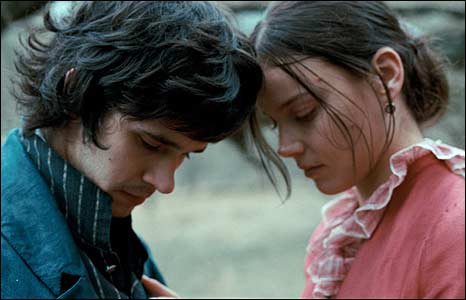
Over the weekend I finally saw Jane Campion's film, Bright Star, about the relationship between the great English poet, John Keats, and his fiance, Fanny Brawne. I wanted to love this movie, because I adore Keats' poetry, and the Romantics and Romanticism in general, and I'm also terribly fond of picturesque period dramas and intense love stories. Yet I came away from Bright Star feeling vaguely disappointed. Let me acknowledge, first of all, that Bright Star is a visual feast. Indeed, there were many things about the film I liked very much. The way it was paced, it's quietness, the lack of obtrusive music, the use of light, color and composition made the film a powerful reflection on a lost way of living and loving, when less was much, much more: small gestures, a touch, a letter, a word meant more and were more deeply felt than is sex itself in our overstimulated age. Though Keats and Fanny never consummated their romance, Campion's portrayal of their whispering, gazing, touching and kissing seemed to me more replete with erotic intensity, more complete, than 90% of Hollywood sex-scenes.
What bothered me about the movie then? Simply that it didn't seem to have anything much to do with John Keats or Fanny Brawne, but rather with two semi-fictional characters bearing the same names. The John Keats in the movie seems to have dropped from the sky, and to be nearly without past, family or friends, except for Charles Brown, portrayed as an odious, boorish bitch of a fellow who is jealous of Keats' relationship with Fanny, and bitterly possessive of Keats' companionship. Within the context of the movie, one couldn't conceive how Keats could voluntarily tolerate the company of such a man, much less his gross discourtesy to Fanny. We learn only through a passing remark that Keats had medical training. We learn in the film of only one of Keats' brothers, and nothing of his sister. We see little of Keats' quick temper, or love of fun. In fact, he seems quite a dull, mooning fellow. Meanwhile Fanny is portrayed as a gorgeously brooding young woman of profound intensity and sincerity, bearing little resemblance to the flirtatious girl whom Keats upbraids in one of his letters for her lack of seriousness.
I couldn't help feeling that Campion was more interested in her own admittedly beautiful vision than in her purported subject. Fortunately, she is an artist of formidable talent, and regarded as a meditation on love and loss in a quieter age, Bright Star is well worth watching.
Subscribe to:
Posts (Atom)